Classifications

There are several types of car seats, which vary in the position of the child and size of the seat. The United Nations European Regional standard ECE R44/04 categorizes these into 4 groups: 0–3. Many car seats combine the larger groups 1, 2 and 3. Some new car models includes stock restraint seats by default.
Group 0edit
Group 0 baby seats, or infant carriers, keep the baby locked up in a rear-facing position and are secured in place by a standard adult seat belt and/or an ISOFIX fitting.
Group 0 carrycots hold the baby lying on its back.
Carrycots are secured by both seat belts in the rear seat of the car. Both types have handles to allow them to be easily moved into and out of the car.
- Position: Laying (in carrycots), rear-facing (in infant carriers), no airbags (with the exception of curtain airbags).
- Recommended weight: Birth to 10 kg (22 lb)
- Approximate age: Birth to 15 month
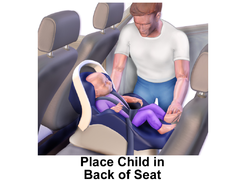
Car Seat - Middle Back Seat

Car Seat - Not in Front Seat

Fastened carrycotsedit
Carrycots or infant car beds are used for children that cannot sit in a regular baby seat, such as premature infants or infants that suffer from apnea. A carrycot is a restraint system intended to accommodate and restrain the child in a supine or prone position with the child's spine perpendicular to the median longitudinal plane of the vehicle. Carrycots are designed to distribute the restraining forces over the child's head and body, excluding its limbs, in the event of a big crash. It must be put on the rear seat of the car. Some models can be changed to face forward after the baby has reached the weight limit which is normally about 15-20 kilograms (33 to 44 lb).
Carrycots generally include a stomach belt and a connection to the (three points) safety belt.
Infant carriersedit
Infant carrier means a restraint system intended to accommodate the child in a rearward-facing semi-recumbent position. This design distributes the restraining forces over the child's head and body, excluding its limbs, in the event of the frontal collision.
For young infants, the seat used is an infant carrier with typical weight recommendations of 5-20 lb. Most infant seats made in the US can now be used up to at least 22 pounds (10.0 kg) and 29 inches (74 cm), with some going up to 35 pounds (16 kg). In the past, most infant seats in the US went to 20 pounds (9.1 kg) and 26 inches (66 cm). Infant carriers are often also called "Bucket Seats" as they resemble a bucket with a handle. Some (but not all) seats can be used with the base secured, or with the carrier strapped in alone. Some seats do not have bases. Infant carriers are mounted rear-facing and are designed to "cocoon" against the back of the vehicle seat in the event of a collision, with the impact being absorbed in the outer shell of the restraint. Rear-facing seats are deemed the safest, and in the US children must remain in this position until they are at least 1 year of age and at least 20 pounds (9.1 kg). although it is recommended to keep them rear-facing until at least 2 years old or until they outgrow the rear-facing car seat height and weight, whichever is longer.citation needed
Group 0+edit
Group 0+ car seats commonly have a chassis permanently fixed into the car by an adult seat belt and can be placed into some form of baby transport using the integral handle if it is the specific model. Rear-facing child seats are inherently safer than forward-facing child seats because they provide more support for the child's head in the event of a sudden deceleration. Although some parents are eager to switch to a forward-facing child seat because it seems more "grown up," various countries and car seat manufacturers recommend that children continue to use a rear-facing child seat for as long as physically possible
- Position: Sitting, rear-facing, no airbag(with the exception of curtain airbags).
- Recommended weight: Birth (2–3 kg) to 13 kg (29 lb).
- Approximate age: Birth to 15 months
Convertible seatsedit
Convertible seats can be used throughout many stages. Many convertible seats will transition from a rear-facing seat, to a forward-facing seat, and some then can be used as a booster seat. Many convertible seats allow for 2.3–18 kg (5-40 lb.) rear-facing, allowing children to be in the safer rear-facing position up to a weight of 18 kg (40 lbs).
Convertible safety seats can be installed as either rear-facing or forward-facing. There is a large selection available to choose from and weight limits, height limits, and extra features vary from seat to seat and by manufacturer. Seats with a 5-point harness are considered safer than those with an overhead shield.
Convertibles aren't considered the best choice for a newborn because the bottom harness slots are often above the shoulders of most newborns. A seat with low bottom harness slots can be used if it is desired to use a convertible from birth.
Rear-facing weight limits range from 9 to 23 kg (20 to 51 lb) depending on the manufacturer and country of origin. Forward-facing limits range from 9 to 40 kg (20 to 88 lb) depending on the seat model and the manufacturer and country of origin.
Most convertible seats in the U.S. have at least a 16 kg (35 lb) rear-facing weight limit, most now to go to 18 kg (40 lb), some 20 kg (44 lb) and a few 23 kg (51 lb). The American Academy of Pediatrics (AAP) recommends that children remain rear-facing until they outgrow their convertible seat, regardless of how old they are. Children can remain in a rear-facing seat until they have either outgrown the weight limit for their seat, or the top of their head is within 25 mm (1 in) of the top of the shell of the car seat.
Group 1edit
A permanent fixture in the car using an adult seat belt to hold it in place and a five-point baby harness to hold the infant.
- Position: Sitting, recommended rear-facing but forward-facing is legal, no airbag (with the exception of curtain airbags).
- Recommended weight: 9 kg to 18 kg (20 lb to 40 lb)
- Approximate age: 9 months to 4 years (Although older children can fit too sometimes)
It is recommended that children sit rear-facing for as long as possible. In Scandinavian countries, for example, children sit rear-facing until around 4 years old. Rear-facing car seats are significantly safer in frontal collisions, which are the most likely to cause severe injury and death. Rear-facing group 1 car seats are becoming more widespread but are still difficult to source in many countries.
Group 2edit
A larger seat than the Group 1 design. These seats use an adult seat belt to hold the child in place.
- Position: Sitting, forward-facing or rear-facing (make sure the seat is certified for up to 25 kg, 55 lb)
- Recommended weight: 15 kg to 25 kg (33 lb to 55 lb)
- Approximate age: 4 to 6 years (Although older children can sometimes fit)
Group 3edit
Also known as booster seats, these position the child so that the adult seat belt is held in the correct position for safety and comfort.
- Position: Sitting, forward-facing
- Recommended weight: 22 kg to 36 kg (48 lb to 76 lb)
- Approximate age: 4 to 10, and above if the child is not 36 kg (48 lb) yet
Booster seatsedit
Booster seats are recommended for children until they are big enough to properly use a seat belt. Seat belts are engineered for adults, and are thus too big for small children. In the United States, for children under the age of 4 and/or under 40 pounds (18 kg), a seat with a 5-point harness is suggested instead of a booster seat.
Booster seats lift the child and allow the seat belt to sit firmly across the collar bone and chest, with the lap portion fitted to the hips. If the seat belt is not across the collar bone and the hips, it will ride across the neck and the stomach and cause internal injuries in the event of a collision.
There are two main types of boosters: high back (some of which have energy absorbing foam) and no back. A new generation of booster seats comes with rigid Isofix (Latch) connectors that secure to the vehicle's anchors, improving the seat's stability in the event of a collision. There are also 3-in-1 car seats that can first be used as a rear-facing baby car seat, then as a forward-facing seat, then finally as a booster seat when the child reaches the recommended height and weight. Unlike many booster seats, 3-1 car seats may use the LATCH system to be secured inside the car.
The consumer groupwhich? is calling on manufacturers and retailers to phase out backless boosters, as it says they don't provide enough protection in side-impact crashes and could put children at risk. So while backless booster cushions are better than using no child seat at all, they do not provide adequate protection in all circumstances.
Front-facing restraintsedit
Used for Groups I, II and III.
After reaching one year of age and 20 pounds (9.1 kg), children may travel in forward-facing seats. Most Scandinavian countries require children to sit rear-facing until at least the age of 4 years. This has contributed to Sweden having the lowest rate of children killed in traffic in international comparisons.
By law (in Canada and some US states), children need to be restrained until they are 4-years old and 40 pounds (18 kg). After the requirement is met, they can move into a booster seat.


Comments
Post a Comment